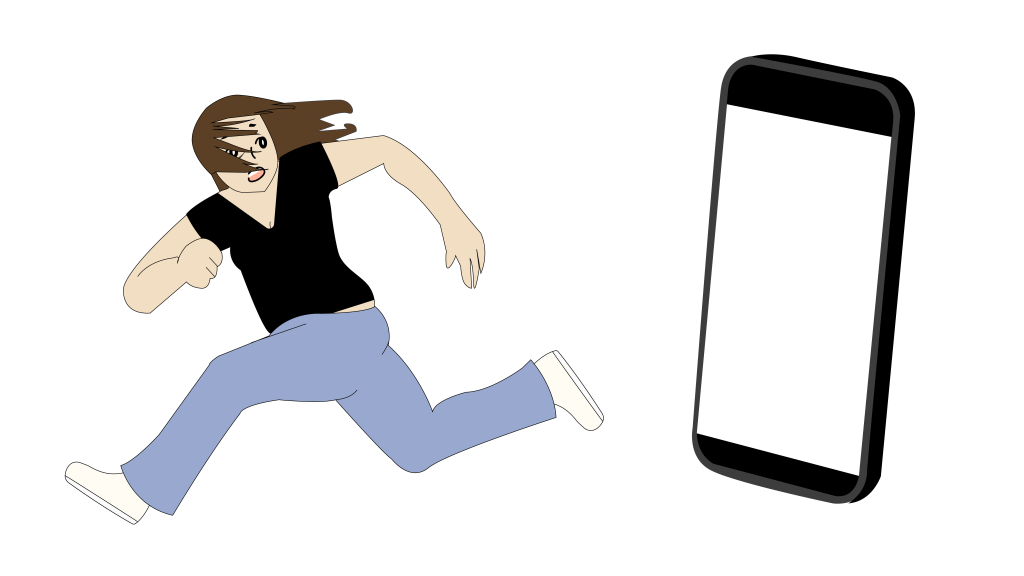
Falling off the grid sounds so cool.
As Johann Hari details his experiences of living with no technology for 3 months in his book “Stolen Focus”… I find myself growing extremely jealous of him. Weirdly, I also find myself being mad at him when he goes back to his old habits after coming home. Like if I had that opportunity I would never return to technology.
I wish I could try. I want to throw away all my technology so badly… but I can’t.
Technology is so embedded in our lives, I’m really not sure if it’s even possible to fall off the grid. I mean of course it is possible, but not without quitting your job or school and losing easy contact with friends and family.
Plus, with the job I’ve chosen to do, unfortunately nothing will be changing for me anytime soon. I intern at a news station over the summer. I work 9 hour days producing a newscast on a computer. That means I’m staring at a screen for almost all my waking hours. And it’s the same at school. The screen time on my phone considers time spent on my laptop too, and I consistently hit 10-12 hours of screen time every day. And I’m not alone. According to numbers from virtual-addiction.com, 31% of Americans say they’re online “almost constantly.”
It’s just the harsh reality of life in our culture. Even if you want to avoid technology for personal use, your other responsibilities will almost always require it.
Even if I could escape, what am I meant to fill my time with? I could pick up a book, but I, like many others, have practically lost my ability to fully comprehend written text. I zone out constantly when I’m trying to read. I can’t focus for more than a page. Again, this isn’t just me. This is actually how humans were originally wired. Author Michael Harris wrote in an opinion piece for The Globe and Mail that it’s primal for us to have fleeting attention. It’s how we survived against predators. Our brains were hijacked by books to have better attention spans, but now with technology that encourages us to scan and move on, we lost it. Unfortunately with it went its benefits like increased focus, comprehension and empathy.
Anyone whose studied journalism has heard this word a billion times from professors, editors and colleagues: concise. “Write and speak in clear and concise sentences a 5th grader could understand” was the first thing I was taught in my first journalism class in college. So when reading through some material about books and focus, I began to question the correlation between humans no longer being able to read long texts, and journalism being pushed toward briefness.
You read a news article from pre-internet eras, like this one from The Guardian in 1901, and it is nothing like the writing we would see today. The writing is far more flowery and descriptive than would be used today. Is that a consequence of people enjoying reading books at the time, so they liked a more narrative piece?
Newspaper articles began being shorter when the telegraph was popularized. The telegraph allowed information to be shared so quickly that the press had to learn to keep up. But today, the main reason for the brevity in journalism is to keep up with our fleeting attention. The question I have is, what came first? Did our attention grow tired from the speed of our information or is our information simply keeping up with our growingly tired attention?
To come back to my initial point of resisting this technology, I’m preparing to embark on a 5 day detox from my main issue, Instagram, which I regularly clock 2 hours per day on. I hope to fill that typical “bed rotting” time with something meaningful, like reading a book.
We’ll see if I stick to it. If my attention-span-deprived brain can really focus on that. If resistance is really futile.
 Past the Byline
Leave a comment