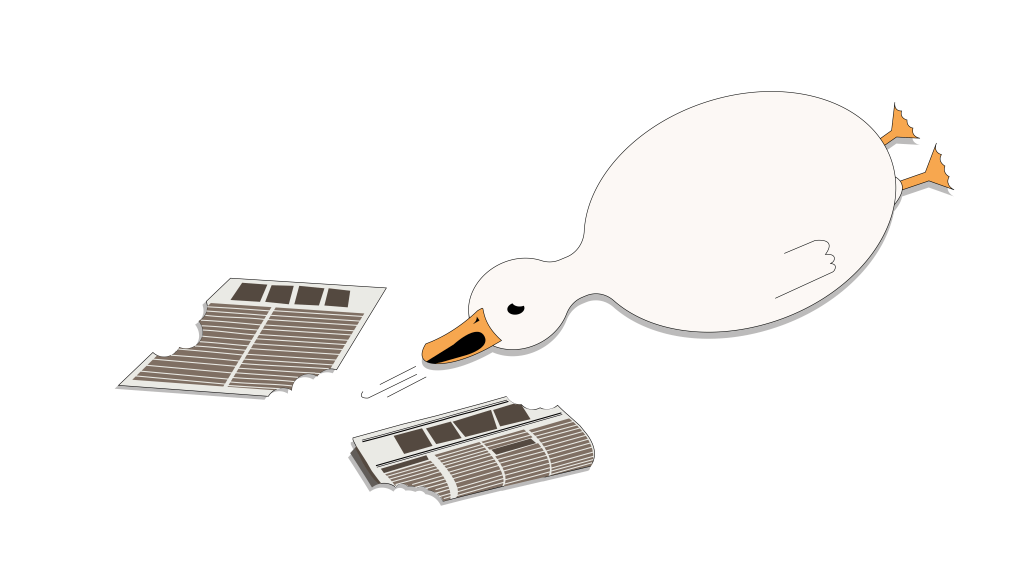
“I fattened myself with information every waking hour to make myself a more productive writer” – Johann Hari, Stolen Focus chapter 1.
Like Hari, I too am a journalist. Also like Hari, I too fatten myself up like a foie gras goose on all the latest headlines. It’s our job right? Knowing what’s happening around the world, or at least on our beat, is the most important thing.
Yet, also like Hari, I’m exhausted. I’m in a complete information overload. I want the news to stop, for the world to slow down just for a moment. But almost equally, I want it to move faster.
I love getting a breaking news notification. I love the feeling of being in a newsroom when a story breaks and everyone rushes to add it to their show. I love the completion of a new story, a new interview, a new pitch idea. I love being on the front lines. But in the long run, it’s not a feasible way to live.
Freelance Feature Writer and Photographer for The Guardian, Anita Chaudhuri wrote an article last year about how she escaped from this news addiction by cutting back to reading print news for one hour a day. Hari details doing something similar in his book. As well as having less anxiety, both of them found they understood the content better. “When I forced myself to focus on only one thing, I realised that I could recall details of what I had read more easily,” Chaudhuri writes.
This information overload doesn’t only overwhelm us, it ruins our comprehension. Sune Lehmann, a professor from the Technical University of Denmark compares it to drinking from a firehose. So much water is coming at us, but you’re probably not swallowing a drop. Inversely, slowing down, doing yoga or meditation actually improves your attention. Lehmann says that’s because we have to “shrink the world to fit our cognitive bandwidth.” We just weren’t made to consume this much.
I think it’s also something correlated to our current political climate. To get political for a moment, in my opinion, democracy is a mess right now. It’s like a car crash I can’t avert my eyes from. Almost any article I read about what’s going on in the White House makes me sad and scared, yet for some reason that feels better to me than not knowing.
In Chaudhuri’s article, she comments on how being tuned into the latest headline feels like a responsibility, “we should all be caring about the suffering of others.” But it shouldn’t be at the detriment of our own mental wellbeing.
The Self Investigation is a non-profit started by a media professional that looks at the mental health of journalists. They found in 2022, more than 60% of journalists reported high levels of anxiety. Burnout in the profession is at an all-time-high.
What can we do?
The International Center for Journalists proposes forming a support network, practicing mindfulness, or finding a good work-life balance (is this one even possible with the hours most of us are required to work?)
But, I think the unfortunate truth is that this is just the reality of the business. To be “good” at it, you need to keep your finger on the pulse.
To steal another quote from Hari, in chapter 3, he writes, “Many of the things we need to do are so obvious they are banal… But even though at some level we all know them to be true, we are in fact moving in the opposite direction.”
Yes, I know what I need to do. But unfortunately my love of the craft trumps my reason. Maybe one day I’ll begin moving in the right direction.
 Past the Byline
Leave a comment